Effects of high-speed deformation on age hardening and microstructural evolution behavior of 6061 aluminum alloys were studied. By affecting the high-speed impact compression (about 5 GPa) to the 6061 aluminum alloy plate in the state of quenching after the solution heat treatment, the maximum hardness became twice as high as the original hardness. Even after the impact compression, age-hardening was clearly identified both at 175 °C and 100 °C. TEM observation revealed that point defect clusters were distributed densely inside grains after the impact compression, possibly due to the effect of high-speed deformation. The point defect clusters observed were assumed to be stacking fault tetrahedra on the basis of high resolution TEM analysis. The point defect clusters and precipitates were both visible even after the peak-aged condition at 175 °C. The 6061 aluminum alloy specimen after the solution heat treatment, followed by the impact compression (8.0 GPa) and the peak-aged condition showed the highest hardness value (154 Hv) among the testing conditions selected in the present study.
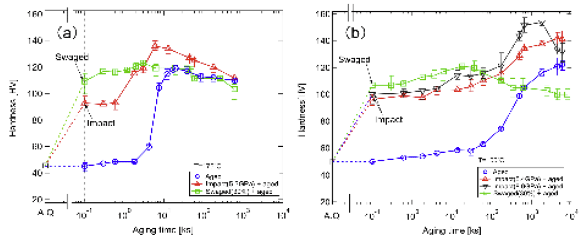
Figure 1 shows the age-hardening curves of 6061 aluminum alloys tested at 175 °C (a) and 100 °C (b). The impact compressive stress corresponded to 5.3 GPa in the 175 °C aging and 5.4 GPa or 8.0 GPa in the 100 °C aging. Axis strain induced by 5.4 GPa of impact compression was about 57 %. For comparison as a low-speed deformation, age-hardening curves of the specimens swaged by 30 % were also presented in the same figure. Owing to the effects of impact compression or swaging, hardenss of specimens increased twice as high as the state of the solution heat treatment. It is also worthwile to note that there shows an increase in the hardness in the specimen after the impact compression in the aging at 175 °C (Fig.1 (a)). The degree of the age-hardening in the specimen with impact compression was 40 DHv, which was slightly lower than that in the specimen without impact compression (59 ΔHv). On the other hand, the swaged specimen by 30 % showed a lower increase in the hardness aged at 175 °C (14 ΔHv), comparing with the specimen with impact compression.
As shown in Fig.1 (b), the specimen with impact compressions followed by aging at 100 °C (Fig.1 (b)) also exhibited the same tendency as the case of 175 °C aging. The specimens impacted by 5.4 GPa or 8.0 GPa both also showed age-hardening at 100 °C. The age-hardening level was totally high when the high impact-compressive stress was introduced. The maximum hardness, 154 Hv was obtained when the specimen with the impact compression by 8.0 GPa was peak-aged at 100 °C. The degree of the age-hardening after the impact compression by 8.0 GPa was 39 ΔHv, the value of which was almost the same as the case of 175 °C aging. In contrast, the maximum aging hardness of the specimen without impact compression was 122 Hv, and the degree of the age-hardening was 72 ΔHv at 100 °C. The swaged specimen by 30 % also indicated a smaller increase of the age-hardening (14 ΔHv) at 100 °C, as compared to the case of impact compression.
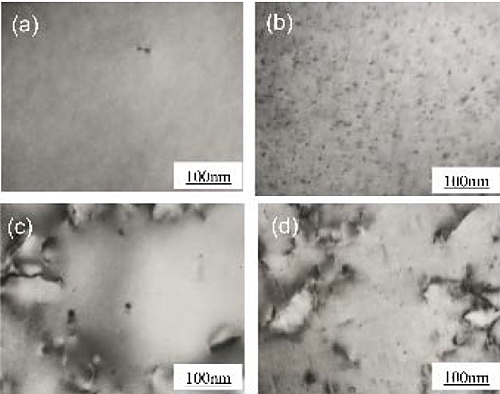
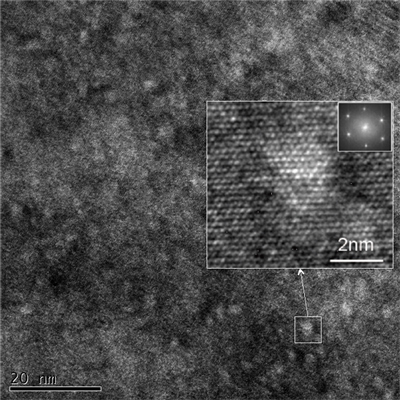
Figure 2 shows the TEM images of the 6061 aluminum alloy. A large number of precipitates (probably, β’’-Mg2Si phase) were homogeneously distributed through the Al grains in the peak aged conditions. It is clear that the increase in hardness is brought about by the distribution of the precipitates for 6061 aluminum alloy. Figure 3 is the typical microstructure observed with a high resolution typed TEM after the impact compression and before the aging treatment. A large number of point defects were clearly observed. The acceleration voltage of 200 kV was used in the present TEM observation, thus, there might be a possibility of electron beam radiation. However, these type of point defects observed already existed even in the beginning of the observation. In addition, morphology of these defects was not rapidly changed after the electron beam radiation within a few minutes. It is thus assumed that these defects are formed by the effect of impact compression. Magnified images of the point defect revealed that the defect was composed of triangle shape when it is observed from [110] direction.