Self-propagating high-temperature synthesis (SHS), also called combustion synthesis, is a powder metallurgical technique that has been performed for preparing inorganic and intermetallic bulk specimens. SHS is also applied to similar and dissimilar welding. SHS is usually applied to the pair of elemental powders, whereby a large amount of heat is generated upon reaction between the two elements. The heat of mixing is, for example, -30 kJ·mol-1, -22 kJ·mol-1 and -11 kJ·mol-1 for the pair of Al-Ti, Al-Ni and Al-Fe elements, respectively. Because SHS is accompanied by the generation of enormous heat of mixing, the cooling rate after synthesis of a bulk specimen or welding often becomes slow. Thus, the grain size in the synthesized bulk specimens or the welded junctions is coarse, which results in low strength. The slow cooling rate often yields undesired and brittle secondary phases. These secondary phases often decrease the strength of the specimens or welded regions. Therefore, industrial application of SHS has been difficult. However, if the heat generated by SHS is small and localized, the shortcomings of SHS mentioned above can be overcome, making the application of SHS viable. In this paper, TiNi intermetallic powder was embedded in an Al matrix to reduce the heat of mixing by SHS as much as possible and to localize the heat in the vicinity of the TiNi particles.
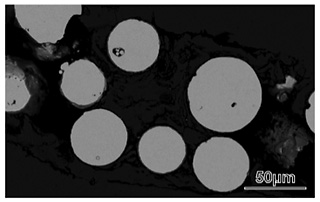
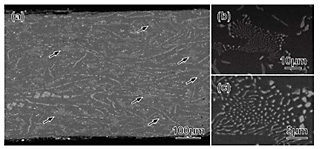
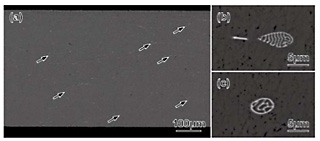
Figure 1 shows the cross-section of the Al-combined ingot embedded with the TiNi powder before plastic deformation. The dark region is the Al matrix and the bright circles are the TiNi particles. During forging and rolling, the specimen temperature increased such that it could not be touched continuously even for several seconds. Figure 2 shows low- and high-magnification images of the microstructure of the specimen obtained by forging one of the combined ingots. In the low-magnification image (Fig. 2(a)), three distinct areas, i.e. the matrix, long precipitates and grey areas, are identified in the specimen. It is revealed by EPMA that the matrix with the darkest contrast is Al. Long precipitates with brighter contrast than the Al matrix were also found everywhere. By observation at higher magnification, it is revealed that the grey areas, some of them are indicated by arrows in Fig. 2(a), consist of the Al matrix and the fine precipitates with the same contrast as the long precipitates. The size of the fine precipitates ranges from 10 µm to less than 1 µm. Therefore, there is a high density of the fine precipitates throughout the cross-section of the specimen. The same microstructural analysis was conducted for the other Al-combined ingot subjected to rolling at room temperature, even though the density of the fine precipitates was considerably lower than that in the specimens obtained by forging. An interesting precipitate morphology was also observed in this rolled specimen at higher magnification, as shown in Fig. 3(b, c). The precipitates formed a lamellar structure with Al, surrounded by a shell of the precipitates. To identify the precipitates with brighter contrast, the microstructure of the specimen prepared by rolling at room temperature was examined by TEM. Based on the EDS analysis, it is considered that the precipitates are Al9FeNi.
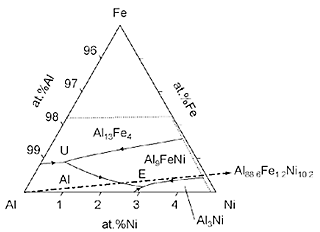
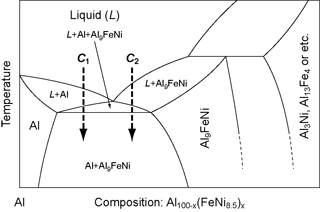
Figure 4 shows the liquidus projection of the Al-Fe-Ni ternary alloy phase diagram in the vicinity of pure Al. The dot-dashed line in Fig. 4 connects the composition of the Al matrix and the Al9FeNi precipitates. Thus, this line intercepts the liquidus plane of the Al phase and the Al9FeNi phase. The vertical cross-section of the Al-Fe-Ni ternary alloy phase diagram along the dot-dashed line in Fig. 4 is schematically illustrated in Fig. 5. Based on this figure, the solidification microstructure of the local melting region formed upon cooling is discussed as follows.
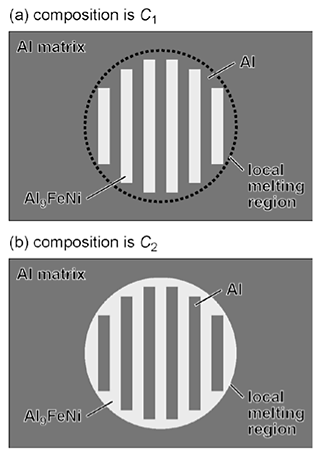
If, it is supposed that the composition of the local melting region is hypereutectic C2, Al9FeNi will precipitate as a shell, followed by the formation of the lamellar microstructure during local solidification. The solidification microstructure for the hypereutectic alloy composition C2 is shown in Fig. 6(b). The morphology depicted in Fig. 6(b) reproduces well the microstructure observed by SEM shown in Fig. 3.
As a consequence, it is revealed that local melting was then induced by microSHS. The lamellar morphology of Al and Al9FeNi implies local melting in the vicinity of the TiNi particle embedded in the Al matrix. The dilution of Ti initially included in the TiNi powder and the concentration of Fe which was an impurity in the Al matrix and the TiNi powder during plastic deformation also implies local melting. Rapid solidification accompanied by local melting is expected to be another mechanism to form an amorphous phase at the boundary of different elements by severe plastic deformation.