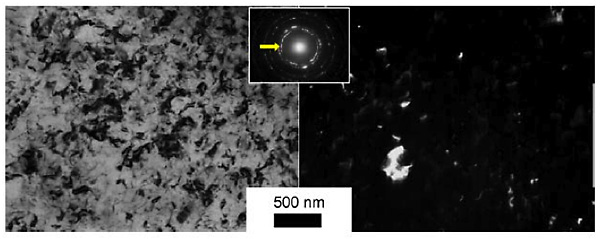
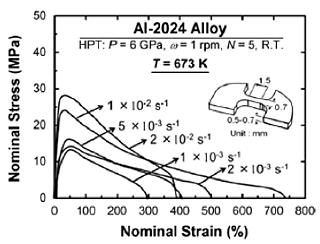
An Al-2024 alloy was processed by high-pressure torsion (HPT) to produce an ultrafine-grained structure with a grain size of  240 nm (Fig. 1). A maximum elongation of 740% was attained with an initial strain rate of 1
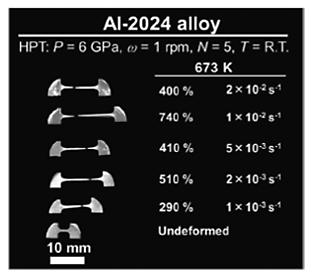
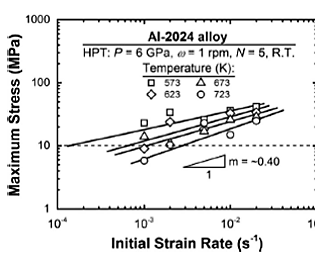
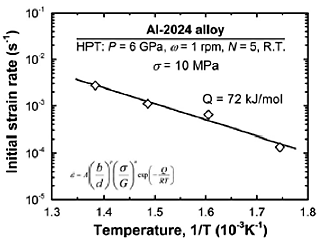
  10-2 s-1 at 673 K (Fig. 2 and Fig. 3), demonstrating the advent of high strain rate superplasticity through grain refinement by the HPT processing. Evaluation of the strain-rate sensitivity and the activation energy for the deformation confirmed that grain boundary sliding through grain boundary diffusion is the rate-controlling process for the superplastic deformation of the HPT-processed Al-2024 alloy (Fig. 4 and Fig. 5).
Grain refinement and high strain rate superplasticity
in aluminium 2024 alloy processed by high-pressure torsion
[Published in Materials Science and Engineering A, 622 (2015), pp. 139-145]
 |
|
|
Fig. 1 TEM bright-field images (left), dark-field image (right) and corresponding SAED patterns (center) for samples processed by HPT for N = 5 at R.T. Dark-field image was taken by diffracted beam indicated by arrow in SAED pattern. |
 |
 |
|
Fig. 2 Nominal stress versus nominal strain for samples processed by HPT through N = 5 revolutions and tensile tested at 673 K. |
Fig. 3 Appearance of tensile specimens after deformation to failure including undeformed specimens for testing temperature of 673 K. |
 |
 |
|
Fig. 4 Maximum stress plotted against initial strain rate with strain rate sensitivity, m. |
Fig. 5 Plots of strain rates taken at stress level of 10 MPa in Fig. 4 against reciprocal temperature. |