Softening by severe plastic deformation and hardening by annealing of
aluminum-zinc alloy: Significance of elemental and spinodal decompositions
A. Alhamidia,b, K. Edalatia,b, Z. Horitaa,b, S. Hirosawac, K. Matsudad and D. Teradae
aDepartment of Materials Science and Engineering, Faculty of Engineering, Kyushu University,
Fukuoka 819-0395, Japan
bWPI, International Institute for Carbon-Neutral Energy Research (WPI-I2CNER), Kyushu University,
Fukuoka 819-0395, Japan
cDepartment of Mechanical Engineering and Materials Science, Yokohama National University,
Yokohama 240-8501, Japan
dGraduate School of Science and Engineering for Research, University of Toyama, Toyama 930-8555,
Japan
eDepartment Materials Science and Engineering, Faculty of Engineering, Kyoto University, Kyoto
606-8501, Japan
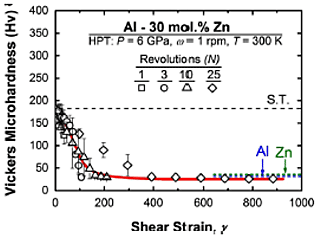
An Al-30 mol%Zn supersaturated solid solutionalloy was severely deformed using high-pressure torsion (HPT) at 300 K and subsequently annealed at 373-673 K. The hardness and tensile strength significantly decreased and the tensile ductility increased with straining by HPT and reached a steady-state level at large imposed strains (Fig. 1 and Fig. 2). Despite this softening behavior, the lattice strain was increased, Zn-rich particles were precipitated and the initial coarse grains were refined significantly to a size of  190 nm while being accompanied by decomposition to Al- and Zn-rich phases because of rapid atomic diffusion (Fig. 3, Fig. 4). The subsequent annealing led to a hardening, but microstructural observations showed that decrease in the lattice strain, increase in the grain size and reduction in the fraction of precipitates occurred by annealing. It was shown that the unusual softening/hardening behavior of the Al-Zn alloy was mainly due to the contribution of spinodal decomposition (Fig. 5). The formation of nano-sized lamellae by spinodal decomposition resulted in increase in hardness after solution treatment and after post-HPT annealing, while this lamellar structure was destroyed by HPT, which resulted in softening. The softening was less significant when the hardness was evaluated at low homologous temperatures.
[Published in Materials Science and Engineering A, 610, (2014), pp. 17-27]
|
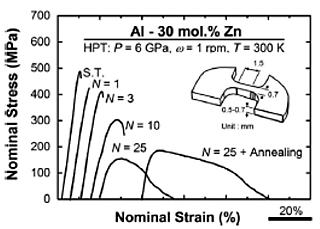 |
Fig. 1 Plots of dS vs. c, where dS is the steady-state grain size and c is the concentration of solute atoms.
|
Fig. 2 Plots of dS vs. c, where dS is the steady-state grain size and c is the concentration of solute atoms. |
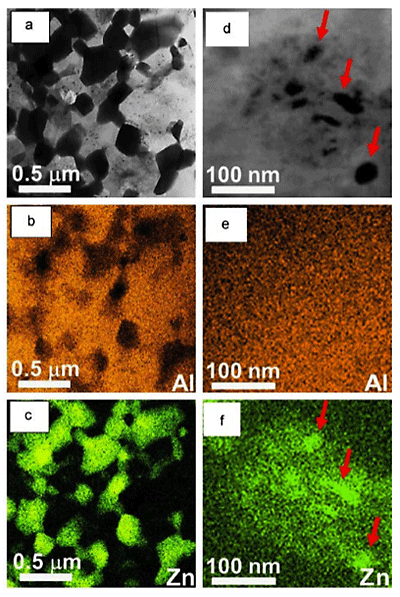 |
| Fig. 3 (a, d) STEM bright-field images and corresponding EDS mappings with (b,e) Al and (c,f) Zn for samples processed by HPT through N=25 revolutions. Zn-rich precipitates were indicated by arrows. |
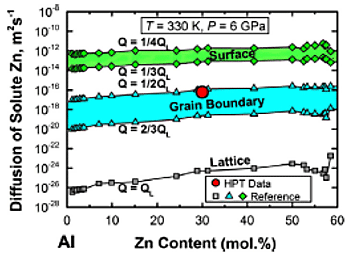 |
| Fig. 4 Estimated diffusion coefficient during HPT processing plotted against Zn content compared with reference data, which were calculated using three different activation energies such as lattice diffusion (Q=QL), grain boundary diffusion (Q=(1/2–2/3)QL) and surface diffusion (Q=(1/4–1/3)QL). |
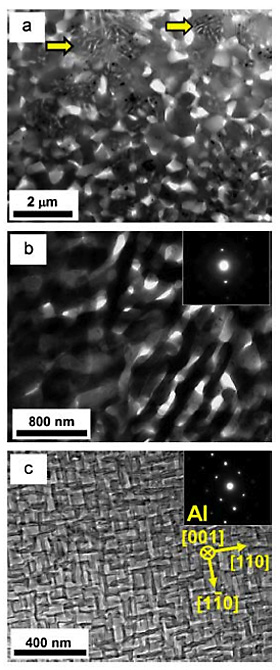 |
| Fig. 5 TEM bright-field images for sample annealed for 24 h at (a) 373 K, (b) 593 K and (c) 673 K after HPT processing through N=25 revolutions. Corresponding SAED pattern of samples annealed at 593 K and 673 K were included. |