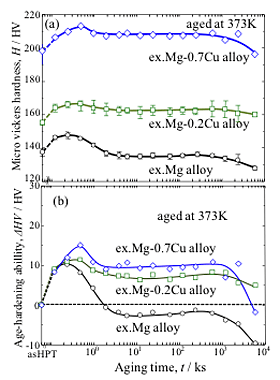
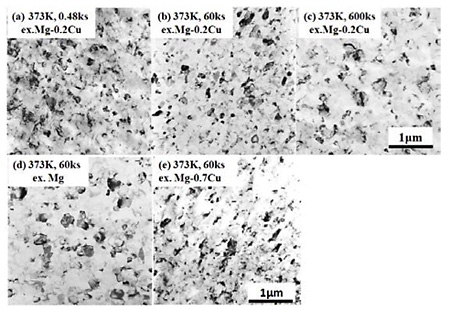
The aging behavior of excess Mg type Al-Mg-Si alloy processed by high pressure torsion (HPT) and effect of Cu addition to this alloy have been investigated by hardness test and microstructure observation. The samples were solution heated, quenched, processed by HPT and aged. Fig. 1(a) shows age-hardening curves of HPT- processed alloys. As the hardness of samples without HPT are about 35-55HV, as HPT-processed samples show higher hardness about 100 HV. HPT-processed samples also showed peak hardness at the early stage of aging. The level of hardness on alloys was increased by increasing with amount of Cu-addition. Two Cu added alloys show positive value of age-hardening ability for the aging condition in Fig. 1(b). Fig. 2 shows TEM bright field images of HPT-processed and aged alloys. The mean grain size in HPT-processed samples was about 200  250 nm for each alloy. Precipitates in HPT-processed and aged samples existed on and near the grain boundaries, and a few small precipitates are found at some dislocations. Fig. 3 shows selected area diffraction (SAED) patterns obtained for HPT-processed alloys aged at 373 K for 60ks. According to the analysis of these patterns, aluminum, Mg2Si and Q-phase are found in the HPT-processed and aged Cu-added alloys. The hardening of HPT-processed samples is probably caused by precipitation at the homogeneous grain boundary networks (GBN) of 200 -250 nm in the sample which acts as heterogeneous nucleation sites for alloys as shown in Fig. 4.
Aging behavior and microstructure on aged excess Mg type Al-Mg-Si alloys after HPT processing
[Published in Journal of Japan institute of light Metals, Vol. 63, No.11, (2013), pp. 406-412]
 |
|
| Fig. 1 (a) Age-hardening curves and (b) age-hardening abilities of HPT-processed alloys aged at 373K. |
|
|
|
|
Fig. 2 TEM bright field images of HPT-processed and aged alloys. ex.Mg-0.2 Cu alloy aged at 373 K for (a) 0.48 ks, (b) 60 ks and (c) 600 ks. HPTed alloys aged at 373 K for 60 ks on (d) ex.Mg and (e) ex.Mg-0.7Cu alloys. |
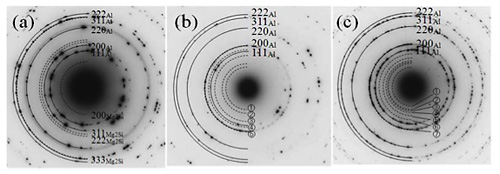 |
| Fig. 3 SAED patterns obtained for HPT-processed alloys aged at 373 K for 60ks. (a) ex.Mg, (b) 0.2%Cu and (c) 0.7% Cu alloys. |
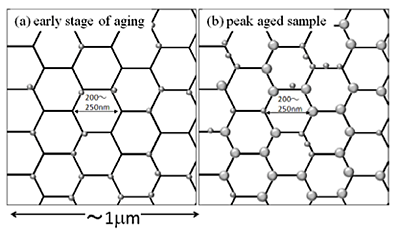 |
| Fig. 4 A schematic illustration of grainboundary precipitation on the nano-scaled structure of grainboundary network (GBN). |