Manabu Nakai1,2 and Goroh Itoh3
1. Graduate Student, School of Science and Engineering, Ibaraki University
2. Kobe Steel, Ltd
3. Department of Mechanical Engineering, Ibaraki University
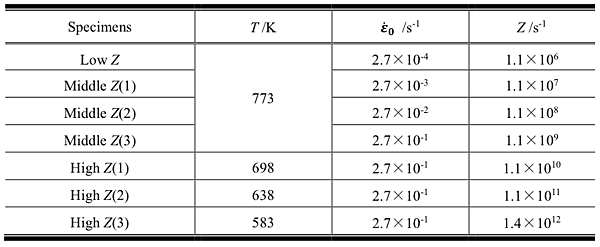
The relationship between the microstructure and the yield strength after T6 tempering was investigated using 6061 aluminum alloy manufactured by hot forging under the conditions indicated in Table 1. Non-recrystallized structures (continuously recrystallized structure) were formed at low Zener-Hollomon parameter (Z-parameter) conditions, which consisted of fine grains surrounded by high angle boundaries and contained low angle boundaries inside. Increasing Z parameter induced fine-grained structures, resulting in increased yield strength. Increasing further Z-parameter caused recrystallization, having coarse (hundreds of micrometers) discontinuously recrystallized grains with high angle boundaries, resulting in significantly reduced yield strength (Fig.1). The yield strength of the material with recrystallized structures was less dependent on the grain size. On the other hand, the yield strength of the materials with non-recrystallized structures was severely dependent on the grain or subgrain size, roughly in accordance with the previous data. Subboundary strengthening appeared to be more effective than high-angle-boundary strengthening (Fig. 2). However, in consideration of the effect of the texture on the yield strength using Schmidt factor,  'crss (the value equivalent to critical resolved shear stress) was less dependent on d' (grain or subgrain size in the slip direction), which means that subgrain strengthening is less effective than high-angle-boundary strengthening (Fig. 3).
[Published in Materials Transactions, Vol.55, No.1 (2014), pp.114-119]
Table 1 Testing conditions of hot forging, T: temperature,  0: initial strain rate, Z: Zener-Hollomon parameter. 0: initial strain rate, Z: Zener-Hollomon parameter. |
|
 |
Fig. 1 Inverse pole figure maps of the three specimens. Grain boundary map is superimposed.  : :   15 15 , ,  : 15>2, where is misorientation angle. : 15>2, where is misorientation angle. |
 |
Fig. 2 Double logarithmic plots between  0.2 - 0 vs. d, assuming that 0.2 - 0 0.2 - 0 vs. d, assuming that 0.2 - 0 d -m. 0: stress derived from Hall-Petch relationship by extrapolating d -1/2 d -m. 0: stress derived from Hall-Petch relationship by extrapolating d -1/2 0. Previous data are also shown. Solid line: for recrystallized grains. Broken lines: for subgrains. 0. Previous data are also shown. Solid line: for recrystallized grains. Broken lines: for subgrains. |
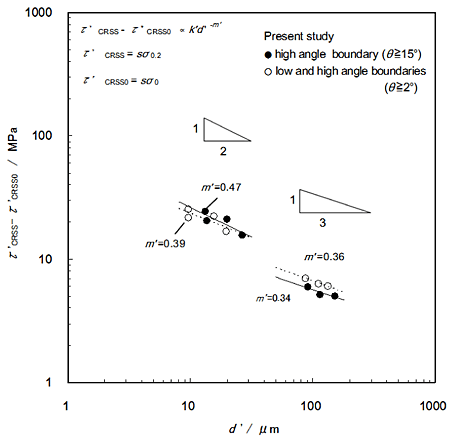 |
| Fig. 3 Double logarithmic plots between ’CRSS - ’CRSS0 vs. d’, assuming that ’CRSS - ’CRSS0=s(0.2 - 0)d -m. s: average Schmidt factor, d’: grain size in slip direction. Solid line: for recrystallized grains. Broken lines: for subgrains. |