Ultrahigh strength and high plasticity in TiAl intermetallics
with bimodal grain structure and nanotwins
Kaveh Edalati,a,b,* Shoichi Toh,c Hideaki Iwaoka,a Masashi Watanabe,d Zenji Horita,a,b
Daisuke Kashioka,e Kyosuke Kishidae and Haruyuki Inuie
aDepartment of Materials Science and Engineering, Faculty of Engineering, Kyushu University,
Fukuoka 819-0395, Japan
bWPI, International Institute for Carbon-Neutral Energy Research (WPI-I2CNER), Kyushu University,
Fukuoka 819-0395, Japan
cResearch Laboratory for High Voltage Electron Microscopy, Kyushu University,
Fukuoka 819-0395, Japan
dDepartment of Materials Science and Engineering, Lehigh University, Bethlehem, PA 18015, USA
eDepartment of Materials Science and Engineering, Faculty of Engineering, Kyoto University,
Kyoto 606-8501, Japan
Nanostructured intermetallics generally exhibit high strength but limited plasticity due to the covalent nature of their bonding. In this study, high-pressure torsion followed by annealing was used to produce TiAl intermetallics with two microstructural features: (i) bimodal microstructure composed of nanograins and submicrometer grains; and (ii) nanotwins as shown in
Fig.1. An exceptional performance, combining ultrahigh yield strength,

2.9 GPa, and high strain to failure, 14%, was achieved with micropillar compression tests as shown in
Fig.2 where twinning, dislocation slip and grain boundary sliding appear to be active under compressive stress. The mechanical properties become independent of the pillar size when the ratio of the pillar size to the grain size is higher than a critical value as shown in
Fig.3. Although there is a trade-off relationship between the strength and strain to failurer, TiAl with bimodal microstructure and nanotwins gives rise to high strength and high ductility as shown in
Fig.4.
[Published in Scripta Materialia, 67 (2012) pp 814-817.]
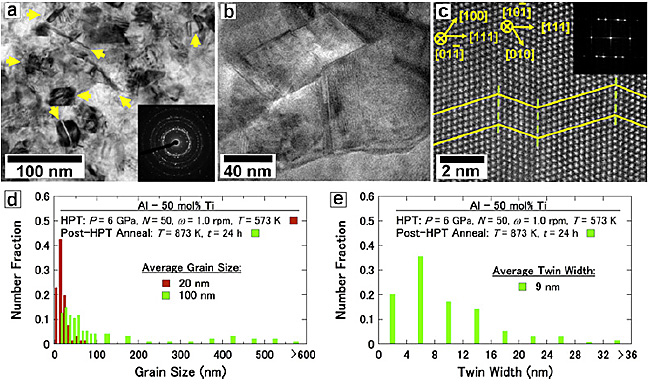 |
| Fig.1. Microstructures of TiAl intermetallic. (a) TEM bright-field image and corresponding SAED pattern of nanograined structure with nanotwins indicated by arrows; (b) TEM bright-field image of a single submicrometer grain containing several twins; (c) STEM lattice image of nanotwins and corresponding diffractogram; (d) grain size distribution for HPT-processed samples before and after annealing; and (e) twin width distribution after annealing. |
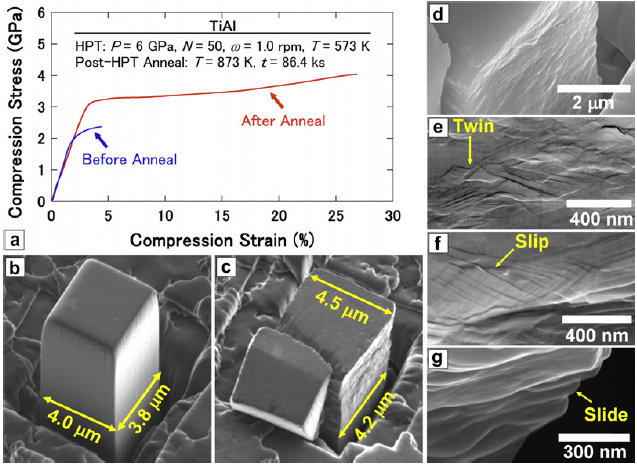 |
| Fig. 2. Micropillar compression test for TiAl intermetallic. (a) Nominal compression stress vs. nominal compression strain curves of HPT-processed samples before and after annealing, (b) appearance of pillar before compression, (c,d) appearance of pillar after compression, (e–g) SEM micrographs taken from pillar side surface and edge after compression. |
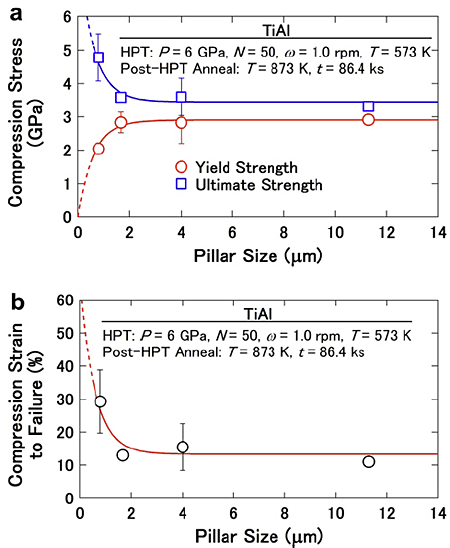 |
Fig. 3. Influence of micropillar size on (a) yield and ultimate compression strength and (b) compression strain to failure.
|
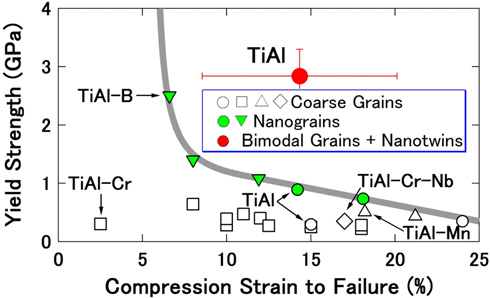 |
| Fig. 4. Plots of compression yield strength vs. compression strain to failure for TiAl with bimodal microstructure and nanotwins. Data for coarse- and nanograined high-purity TiAl and coarse- and nanograined TiAl with alloying additives are also included. |