Precipitates refinement of hypereutectic Al-Si alloy is effective for improvement of its mechanical properties. Our original severe plastic deformation process named Compressive Torsion Process (CTP) is effective for not only grain refinement but also precipitates refinement. In the present work, the CTP was applied to an extruded hypereutectic Al-Si alloy and changes in mechanical properties were investigated.
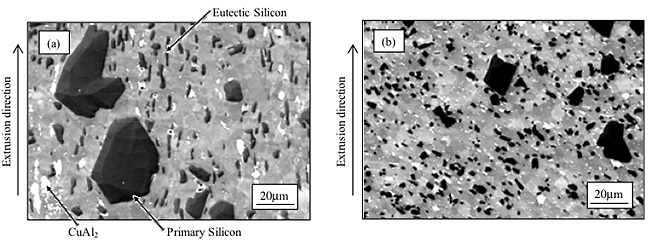
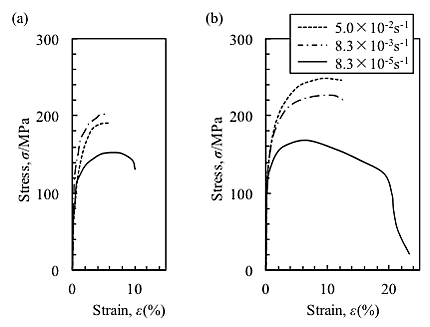
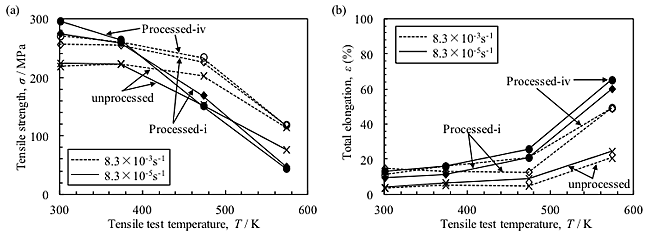
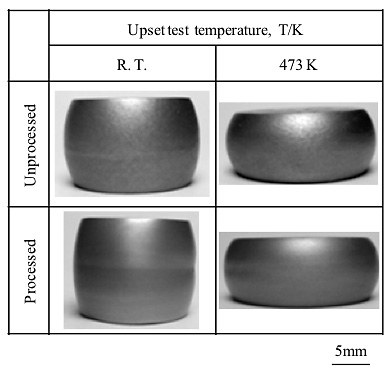
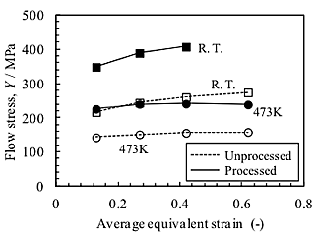
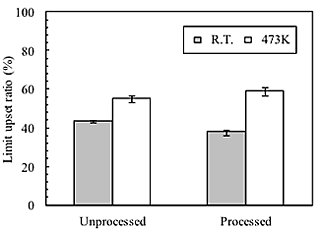
Fig.1 shows microstructure of before and after CTP processed at 473K with 20 revolutions. Large primary silicon precipitates over 50 m were refined less than 20m by the CTP. And small and elongated eutectic silicon particles were also refined less than 5mm. Mechanical properties of specimens which were unprocessed and processed with 20 revolutions at 473K were investigated through the tensile test and upset test. The tensile test was carried out at R. T. to 573K with 3 initial strain rate conditions. Fig.2 shows stress-strain curves of unprocessed and processed specimens tested at 473 K with various initial strain rates. Fig.3 shows tensile strength and total elongation of those specimens as a function of tensile test temperature. As a result, tensile strength of processed specimen is increased at R. T. and 373K. The initial strain rate affects the tensile strength at high temperature, low strain rate decreases the tensile strength compared with unprocessed specimen. Total elongation of processed specimen is increased more than twice as unprocessed specimen. Local elongation is increased at high temperature with low strain rate. The upset test was carried out at R. T. and 473K. Fig.4 shows appearances of free surface of unprocessed and processed specimen after upset test at R. T. and 473 K. The unprocessed specimen has rough surface after upsetting, while the processed one has very smooth surface. Fig.5 shows flow stress of unprocessed and processed specimens as a function of average equivalent strain, which was predicted from upset test at R. T. and 473 K. The flow stress of processed specimen is higher than unprocessed specimen. Fig.6 shows the limit upset ratio of unprocessed and processed specimen tested at R. T. and 473 K. The limit upset ratio of processed specimen is higher than unprocessed specimen tested at 473K.