Analysis of microstructure evolution and precise solid fraction evaluation of A356 aluminum alloy during partial re-melting by a color etching method
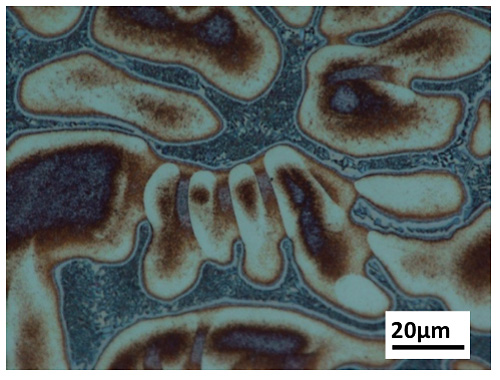
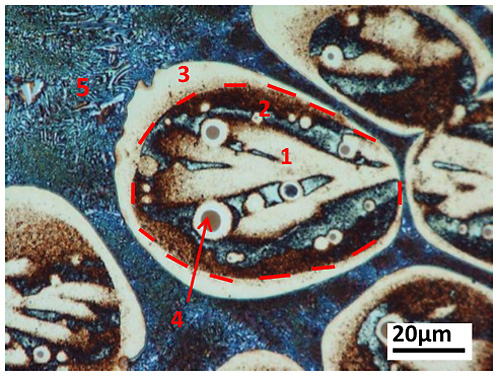
Semi-solid processing has many advantages in the production of parts with complex shape. In semi-solid processes, the spheroidization of Al grains is required for the production of semi-solid slurry either by a partial solidification route or partial re-melting route. In this research, A356 aluminum alloy was compressed and then partially re-melted to semi-solid state before water quenching. A segregation sensitive reagent (Weck's reagent) was used to reveal the inner microstructure of Al grains for the better understanding of the microstructure evolution during partial re-melting. Fig. 1 shows the dendritic optical microstructure after etching by Weck's reagent. The color difference inside dendritic Al grains indicates the micro-segregation occurred during solidification. After the dendritic microstructure was compressed and partially re-melted, the Al grain was spheroidized, whose microstructure after etching by Weck's reagent is shown in Fig. 2. In the case of spheroidal grain, the original as compressed dendritic structure (indicated as No. 1 in the figure) was surprisingly revealed inside the spheroidal grain. The grain growth formed during water quenching (indicated by No. 3 in the figure) was also visualized. Consequently, precise evaluation of solid fractions through image analysis was realized by excluding the growth layer when measuring the area of solid phase. Results are summarized in Fig. 3. The overestimation of solid fraction (red line and points) could be avoided by using Weck's reagent (blue line and points). We also investigated the microstructural evolution from dendritic grain to spheroidal grain. Detailed optical microstructure observation in Fig. 4 showed that the previously compressed Al dendrites were actually "fractured" during heat treatment and such "fractured" dendrites contributed to the refinement and spheroidization of Al grains. Further study of this phenomenon indicates that the "fractures" are actually migrating high-angle grain boundaries, which was related to the recrystallization that occurred during heat treatment.
[Published in Journal of Materials Science, Vol. 47, Issue 18 (2012) pp. 6553-6564]
 |
|
| Fig. 1 Microstructure of as received specimen after etching by Weck’s reagent. |
|
|
|
|
Fig. 2 Representative microstructure of the spheroidal grain after water quenching. |
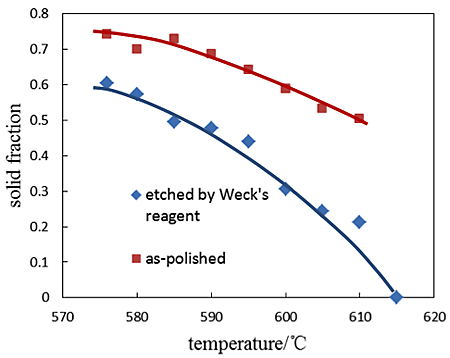 |
| Fig. 3 Solid fractions measured before etching and after etching. |
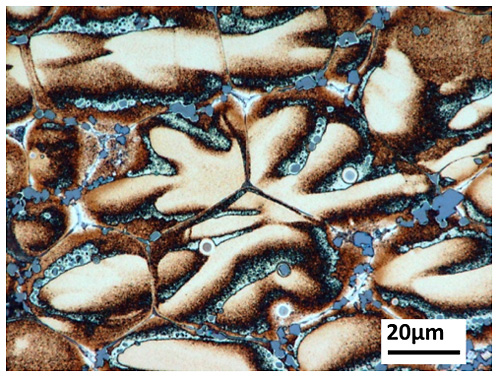 |
| Fig. 4 "Fractured" dendrites observed during heat treatment. |