Titanium and aluminum sheets were directionally strained by friction roll surface processing (FRSP). Severe shear strain was imposed into the surface layer and strain gradient was formed through the thickness of the sheet. The microstructure and texture in as-strained state were investigated by optical microscopy and X-ray diffraction technique. The evolution of microstructure and crystallographic texture of FRSPed samples during annealing were studied by electron back-scattered diffraction (EBSD) technique.
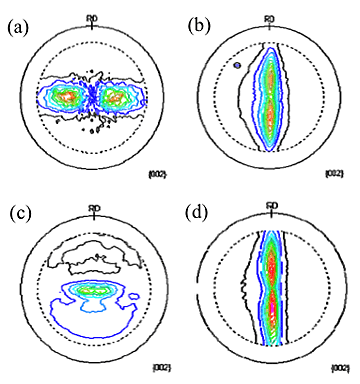
The normalized (0002) pole figures of the CP Ti and HP Ti after FRSP measured by XRD are presented with Polar net in Fig. 1. As displayed in Fig.1 (a), (0001) pole figure of the as received CP Ti indicates that the basal poles are tilted 30-40 away from the ND toward the TD, thereby exhibiting a TD-split texture ({1214}
 1010
1010 or {0225}2110 ({rolling plane}rolling direction)) that is commonly observed in annealed titanium sheets after rolling. Figure 1 (b) describes the main textures in the ND/TD FRSPed one. The FRSPed sample has a sharp texture showing dense contour lines in TD, which is closed to RD split, that is, the basal poles are tilted 20
 30 from rolling plane normal toward the RD. It is interesting to notice that the deformed texture of HP Ti after FRSP becomes more pronounced (Fig. 1(d)) than that of CP Ti (Fig. 1(b)).
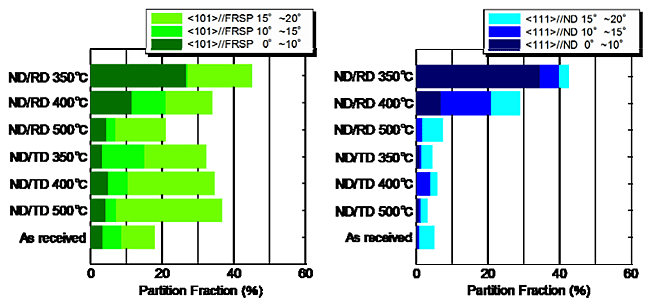
The typical shear texture was also observed in FRSPed and annealed aluminum samples. The
shear texture of the aluminum is characterized as 101//FRSP direction and 111//ND, which
means that slip direction is parallel to FRSP one while slip plane is parallel to the plane subjected to FRSP. Figure 2 shows area fractions of both directions formed by FRSP and subsequent annealing.
FRSP/A aluminum samples exhibit much higher fractions of both directions compared with an
as-received.