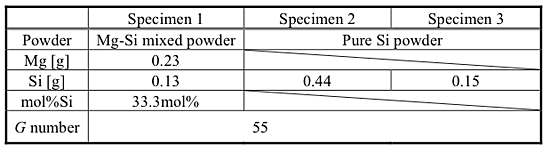
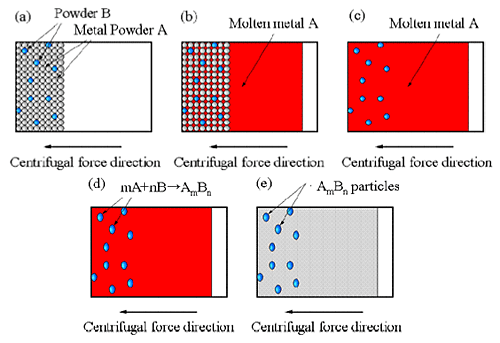
In this study, as a novel centrifugal mixed-powder method, reaction centrifugal mixed-powder method was applied for Mg-Si system to fabricate Mg/Mg2Si functionally graded materials (FGMs). A schematic illustration showing the process of the reaction centrifugal mixed-powder method is shown in Fig. 1. In advance, the mixed powder of Mg and Si particles is inserted into a rotationable mold (Fig. 1 (a)), and then the molten Mg is poured into the mold with the powder mixture (Fig. 1 (b)). As a result, the molten metal matrix penetrated into the space between the particles due to the pressure exerted by the centrifugal force. At the same time, Mg particles were melted by the heat from the molten Mg (Fig. 1 (c)), and it allowed the occurrence of Mg/Si reaction (Fig. 1 (d)). Using this method, Mg/Mg2Si FGMs with gradual distribution of Mg2Si particles was successfully fabricated (Fig. 1 (e)). Casting conditions of each specimen are shown in Table 1.
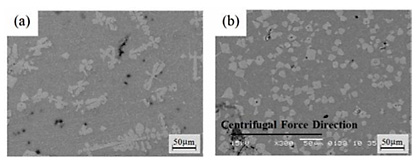
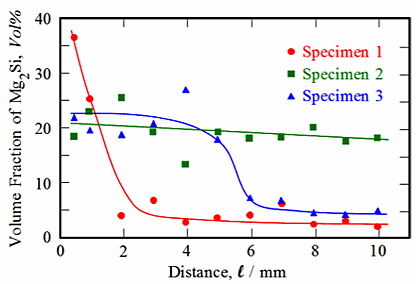
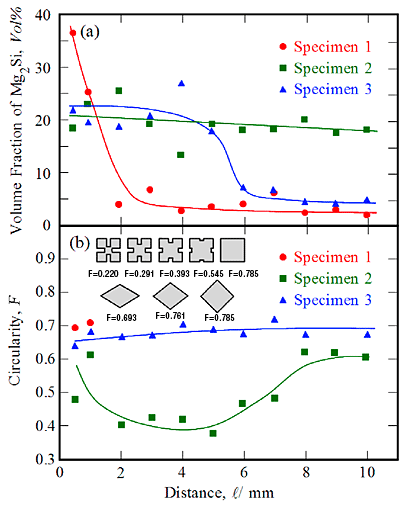
Figures 2 (a) and (b) show the SEM micrographs of cross-sectional plane of specimen 2 and specimen 3, respectively, at the tip region of the samples. Relatively smaller Mg2Si particles were observed in specimen 3 while the dendrite-shaped particles of Mg2Si could be found in specimen 2. Therefore, the size and shape of Mg2Si phase could be controlled by the process conditions. The distributions of Mg2Si phase in specimens 1 to 3 are shown in Fig. 3. As can be seen, volume fraction of Mg2Si particles in the specimen changes from place to place. Figures 4 (a) and (b) show the volume fraction and circularity of Mg2Si primary crystals in the specimens, respectively. Particles size and morphology of Mg2Si particles in the FGMs depend on the amount of Si particles in mixed powder. This is because the reaction heat due to the reaction of Si particles and molten Mg is influenced by the amount of Si particles. Therefore, it can be concluded that the reaction heat is important factor for the reaction centrifugal mixed-powder method, and it controls the microstructure of the FGMs.