It is important to understand the deformation mechanism of yielding in metals to improve their plasticity. In hcp metals, (0001) basal slip and (1010) prismatic slip systems are well known but total number of these independent slip systems is four. According to the von-Mises criterion, another non-basal slip systems must be activated to deform the polycrystalline materials uniformly. It has been reported that {1122} < 1123 > second order pyramidal slip is activated in magnesium single crystals. To improve plasticity of magnesium, it is necessary to increase the activity of such non-basal slips. Generally magnesium is used as magnesium alloys. Zinc and aluminum are major alloying element of them all. The effect of aluminum and zinc addition on deformation behavior in magnesium single crystals was reported that critical resolved shear stress (CRSS) due to basal slip increased by aluminum and zinc addition. However, the effect of zinc and aluminum on non-basal slip in magnesium is not well known. From the viewpoint, deformation behavior of Mg-Zn and Mg-Al alloy single crystals has been investigated in [1120] tension and [0001] compression.
Mg-0.1at%Zn, Mg-0.5at%Zn, Mg-0.5at%Al and Mg-1.0at%Al alloy ingots were made by high frequency induction furnace. The alloy single crystals were grown by Bridgeman method.
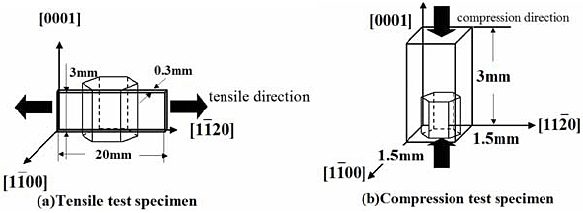
Figure 1 shows [1120] tension and [0001] compression test specimens. The size of each specimen was 3 0.320 mm and 1.51.53.0 mm, respectively. Tension and compression test was carried in a temperature range from 77K to 473K at initial strain rates was 4
  810-5 / s.
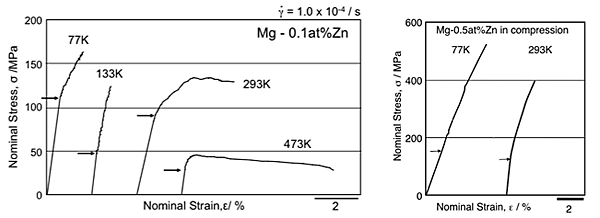
Figure 2 shows typical stress-strain curves of Mg-0.1at%Zn in tensile at the range from 77K to 473K and Mg-0.5at%Zn in compression at 77K and 293K, respectively. In Mg-0.1at%Zn, while the flow stress after yielding increasing linearly at 77K and 133K, the flow stress at 473K didn't show work hardening. This result indicates that deformation behavior by non-basal slip change drastically above room temperature.
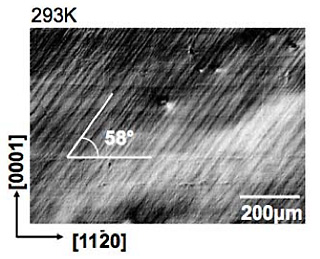
Figure 3 shows etch pit bands of Mg-0.1at%Zn at 293K. These pit bands indicated that the Mg-0.1at%Zn was yielded by {1122} < 1123 > second order pyramidal slip system. Mg-0.1at%Zn and Mg-0.5at%Zn were deformed by the non-basal slip system in all temperature range.
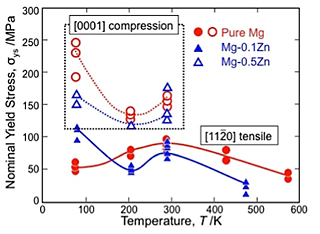
Figure 4 shows temperature dependence of yield stress in Mg-Zn. The yield stress of Mg-Zn alloys increased in the range form 203K to 293K, namely, the yield stress of second order pyramidal slip shows anomalous temperature dependence in the range from 203K to 293K. However, the yield stress decreased with increasing temperature above 293K. Yield stress also decreased by small amount of zinc addition in the temperature range from 203K to 473K. However, the yield stress of Mg-Zn at 77K is two times higher than that of pure magnesium. According to dislocation mechanism of second order pyramidal slip, decrease of yield stress by second order pyramidal slip would be explained by decreasing of immobilization of (c+a) edge dislocation by increase of basal slip by zinc addition.
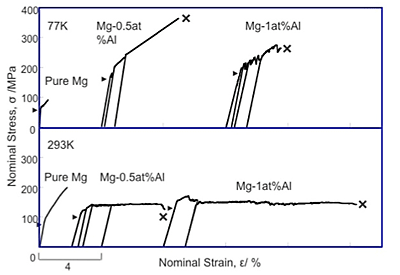
Figure 5 shows the typical stress-strain curves of Mg-Al at 77K and 293K. At 77K, yield stress was increased by aluminum addition, while strain- hardening rate of Mg-0.5at%Al was similar to that of pure magnesium. At 293K, stress-strain curve of Mg-Al alloys was drastically changed. There is no strain hardening on these curves after yielding and small serration of flow stress was also observed.
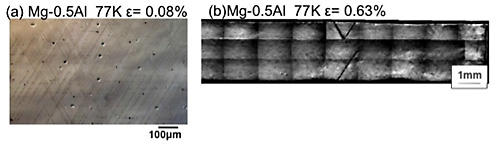
Figure 6 shows etch pit bands observed on (1100) surface of Mg-0.5at%Al after yielding at 77K. These etch pit bands indicates that Mg-0.5at%Al was yielded by second order pyramidal slip.
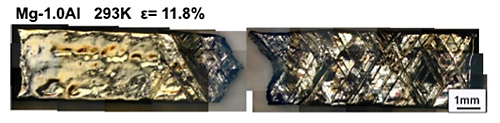
Figure 7 shows {1011} twin observed on Mg-1.0at%Al at 293K. Mg-1.0at%Al was yielded and deformed by {1011} twins.
Figure 8 shows temperature dependence of yield stress in Mg-Al single crystals. Mg-Al alloys were yielded by second order pyramidal slip at 77K and Mg-0.5at%Al was yielded by the slip at 293K. This result indicates that CRSS of second order pyramidal slip increase with increasing aluminum content. However, Mg-1.0at%Al was yield by {1011} twin at 293K. CRSS of {1011} twin in pure magnesium singly crystal was also plotted in the figure. From the results, we conclude that CRSS of {1011} twin decreased under the CRSS of the pyramidal slip by aluminum addition, therefore, deformation mode of Mg-1.0at%Al changed to {1011} twin.
Effect of alloying element to deformation behavior of magnesium non-basal slip was investigated by [1120] tensile and [0001] compression test using single crystal. Obtained results are summarized as follows: Both Mg-0.1at%Zn and Mg-0.5at%Zn were deformed by {1122} < 1123 > second order pyramidal slip. CRSS of second order pyramidal slip decreases by zinc addition. Both Mg-0.5at%Al and Mg-1.0at%Al were deformed by second order pyramidal slip at 77K. Mg-1.0at%Al was deformed by {1011} twin at 293K. CRSS of second order pyramidal slip increase and that of {1011} twin decrease by aluminum addition
 =3.7%.