In order to investigate the behavior and mechanism of creep at low stress in a dispersion-strengthened Al-Mg alloy with fine grains, creep tests were carried on Al-5356 alloy with grain size, dg = 5  m by the helicoid spring specimen technique at homologous temperatures ranging from 0.63Tm to 0.74Tm and applied stresses of 0.13
  1.42 MPa. We also performed microstructural observation using transmission electron microscopy (TEM) / scanning TEM (STEM) to compare the change in the microstructure of recrystallized and as-crept specimens.
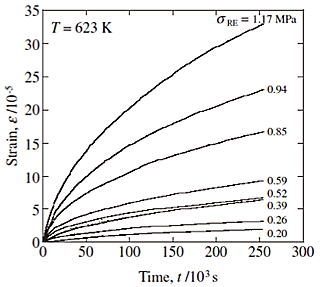
Figure 1 shows typical creep curves of Al-5356 alloy at 673 K. All of the creep curves exhibit a transient stage, and no apparent steady-state stage. Therefore, the Li's equation was used to fit the curves to obtain a steady-state strain rate, which is based on the multiplication and exhaustion (immobilization) of dislocations in the transient creep stage. A plot of effective stress (applied stress minus threshold stress), 
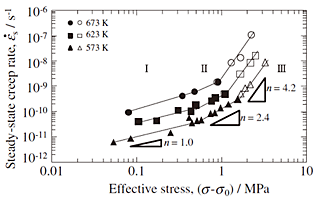
 0, against the steady-state strain rate,
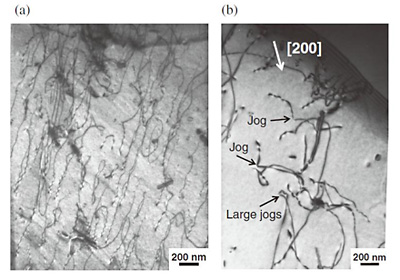
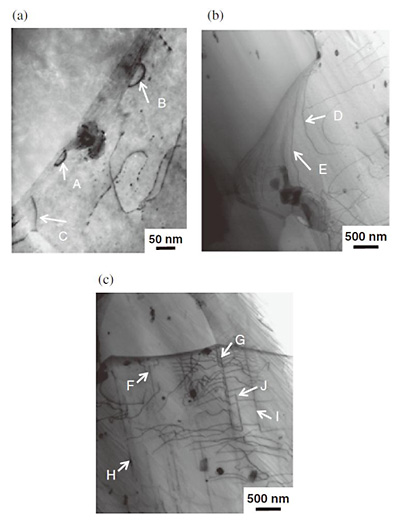
  s, in a double-logarithm format for all data investigated by helicoid spring creep tests at different temperatures is shown in Fig. 2, in which three distinct regions can be observed. Figure 3 shows TEM and STEM images of dislocation substructures crept at 623 K in region II. Dislocations emitted from grain boundaries, which begin as small semicircles indicated by arrows A, B and C in Fig. 3(a) and then breaking up, as indicated by arrows D and E in Fig. 3(b). The emitted dislocations then glide along slip planes marked by arrows G and F in Fig. 3(c). However, an array of dislocations which is generally observed in pile-ups was not observed in this study partly because of hinder dislocation glide. On the other hand, slip lines / bands indicated by arrows I and H in Fig. 3(c) and the cross slip of intragranular dislocations indicated by arrow J are also present. These features are not usually reported for grain boundary sliding (GBS) and may be associated with the creep mechanism in region I. The shape, configuration and arrangement of dislocations in grains crept to a steady-state creep stage at 623 K in region I are shown in Fig. 4. According to these images dislocations have the following characteristics: (i) they are relatively long, randomly distributed and predominantly edge dislocations, (ii) curved dislocations appear over precipitates, (iii) jogged dislocations are formed, and (iv) there is a lack of subgrains. Based on these results, we discussed the creep mechanism of Al-5356 alloy and concluded as follows. The creep mechanism of region III is consistent with dislocation climb, but the measurement error is quite large due to complicated stress redistribution. In region I, Bingham-type viscous creep with an activation energy equal to the dislocation core diffusion energy is dominant. The formation of jogs on edge dislocations and the mechanistic creep parameters suggested the possibly of a mechanism controlled by Harper-Dorn creep, which is controlled by dislocation core diffusion. The motion of jogs on edge dislocations dependent on dislocation core diffusion has been suggested as the rate-controlling mechanism of creep. In region II, the results regarding the stress exponent, n = 2, and the activation energy, Q = 85 kJ/mol, lattice dislocation emitted from grain boundaries, the formation of slip bands as well as the mechanistic creep parameters indicated that the dominant creep deformation mechanism is GBS accommodated by slip. The creep rate-controlling mechanism is hardening and recovery of lattice dislocations within grain boundaries.
 = 6
= 6 10-5 in region II show (a) dislocations which appear as semicircles, as indicated by arrows A, B and C, are emitted from the grain boundary, (b) emitted dislocations break up, as indicated by arrows D and E, (c) emitted dislocations move along slip planes, as indicated by arrows G and F, intragranular slip, as indicated by arrows I and H and intragranular dislocation cross slip as indicated by arrow J.