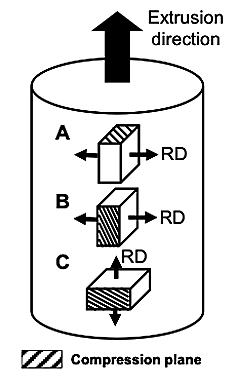
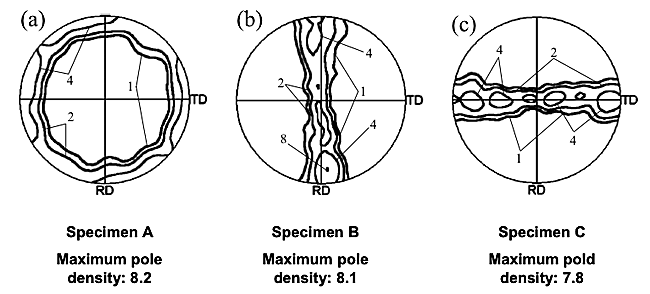
The formation behavior of textures during high temperature plane strain compression deformation is experimentally studied on AZ80 magnesium alloy. Figure 1 shows the three kinds of specimens (named A, B and C) prepared from the extruded bar with different geometries. The bar has a <1010>(extrusion direction) fiber texture and hence the three specimens have different initial textures. Figure 2 shows the (0001) pole figures showing the crystallographic characteristics of the specimens A, B and C. Pole densities are projected onto the compression plane. Mean pole density is used as a unit to draw contours. Figure 2(a) shows that (0001) is distributed in a concentric circular manner about 90 degrees from the compression axis in the specimen A. On the other hand, (0001) planes are distributed around the extension direction in the plane strain compression and the transverse direction in specimens B and C, respectively.
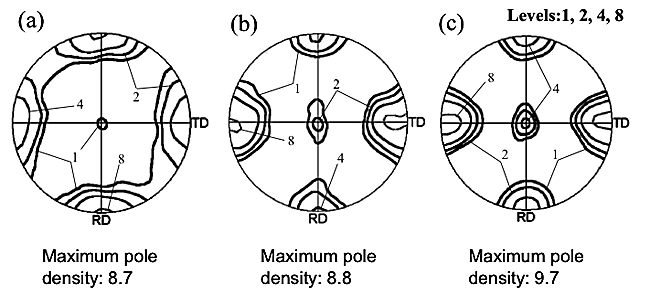
Plane strain compression deformation results in the drastic change in the orientation distribution. Figures 3(a), (b) and (c) show the (0001) pole figures of specimen A observed after the deformation up to  0.4, 0.7 and 1.0, respectively. Plane strain compression was conducted at 723K with a strain rate of 5.0
 10-2s -1. As shown in Fig. 2(a), no pole density is seen in the center of the (0001) pole figure before deformation. Slight accumulation of pole density is seen in Fig.3 (a) and the intensity at the center of the (0001) pole figure increases with an increase in true strains up to 1.0. It is also seen that pole densities are not distributed continuously from the periphery of the pole figure. This suggests that (0001) pole density at the center do not originate from the slip deformation. Microstructure observation by EBSD shows that deformation twin appears at a strain of 0.4 and the frequency of twin increases up to a strain of 0.7. At a strain of 1.0, many crystal grains having the orientation close to (0001) are observed. This indicates that the basal texture component originates from the tensile twinning at the initial stage of deformation.
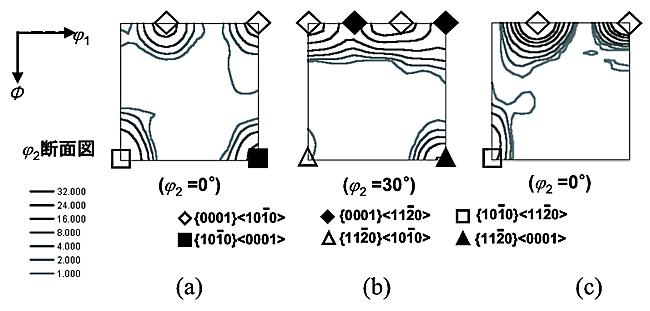
Figure 4 shows the orientation distribution after the deformation at 723K with a strain rate of 5.010-2s -1 up to a true strain of 1.0 for the three kinds of specimens. The  2 sections are derived from the orientation distribution function calculated by the Dahms-Bunge method. The sections indicate that the textures consist of several components. The indices of the texture components are given below the figures. It is seen that the texture components vary depending on the initial texture. However, (0001)<1010> and {1120}<1010> are formed irrespective of the initial texture.
The meaning of these texture components is examined on the basis of slip deformation. Crystallographic examination on the relationship between basal, prismatic and pyramidal slip systems and the observed texture component suggests that the texture components have characteristics where no extensive lattice rotation is expected because of the symmetry of the orientations against the slip systems. Thus it is considered that all the texture components are orientations stable for the plane strain compression.
 59. ]
59. ]
 2 =0
2 =0 section), (b) B (