Effect of Anodizing Condition on Corrosion Resistance of Mg-Li-Y Alloy
Sachiko Ono, Yayoi Suzuki, and Hidetaka Asoh
Department of Applied Chemistry, Faculty of Engineering, Kogakuin University
2665-1 Nakano, Hachioji, Tokyo 192-0015, Japan
Effects of anodizing conditions on corrosion resistance of Mg-Li-Y alloy, which is most prominent super light alloy capable for easy deformation, were investigated with attention to the formation behavior and microstructure of anodic films. Barrier films or semi-barrier films were formed except at around 7V and breakdown voltages similar to those associated with typical pure magnesium and AZ alloys as shown in Fig. 1. At the former voltages, thick porous type films were formed. The critical voltage of high current flow accompanied by breakdown was dependent on substrate composition; 45V for MgLiY alloy, 60V for 99.95% Mg and 120V for AZ91D. When aluminate or phosphate ion was added in the electrolyte, the critical voltage of MgLiY alloy increased to 100V (Fig. 2). Lithium was highly enriched at the outer part of the film and yttrium was enriched in the middle to inner part when the film was barrier type as shown in Fig. 3. The ratio of barrier film thickness to anodizing voltage was as high as 4.25 nm/V compared to 1.9 nm/V of that associated with 99.95% Mg (Fig. 4). When the film was porous type, the content of both lithium and yttrium decreased and distribution of both elements became uniform. Anodic films formed in sodium phosphate solution followed by sealing treatment in silicate exhibited sufficient corrosion resistance for practical usage (Fig. 5).
[Published in J. Jpn. Inst. Light Metals, Vol. 61, No. 2 (2011), pp. 60-65]
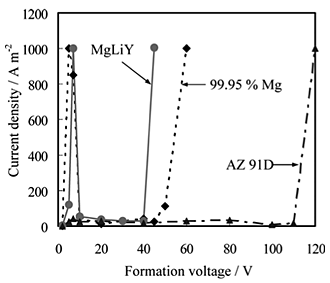 |
| Fig. 1 Effect of substrate composition on voltage - current characteristics of anodizing in NaOH solution. Anodizing was performed for 10min at 298K. |
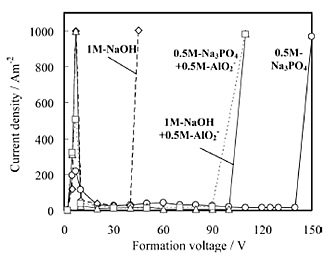 |
Fig. 2 Effect of electrolyte composition on voltage - current characteristics of anodizing of Mg-Li-Y alloy. Anodizing was performed for 10min at 298K. |
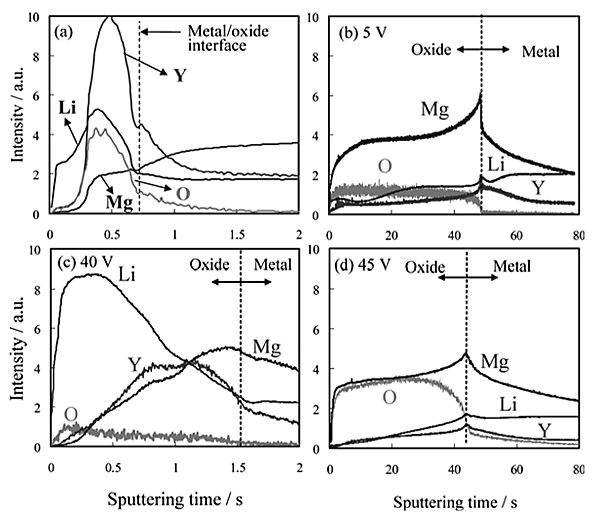 |
Fig. 3 GDOES depth profiles of constituent elements of anodic film formed on MgLiY alloy in NaOH solution at different voltage. (a) After chemical polishing. (b) 5 V. (c) 40 V. (d) Breakdown voltage at 45 V. |
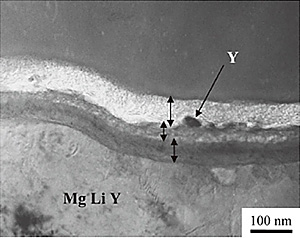 |
Fig. 4 TEM image of the cross section of MgLiY alloy anodized in NaOH solution at 40V. An arrow indicates yttrium particles embedded in the inner layer of the film. Three arrows in the film indicate outer, middle and inner layers respectively. |
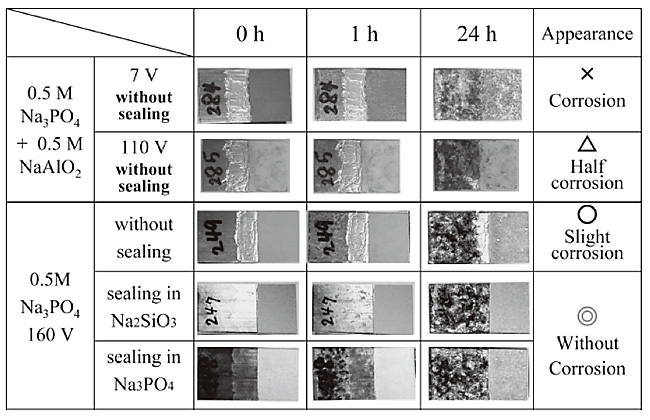 |
Fig. 5 Surface appearance of anodic films formed on MgLiY alloy at different conditions after salt spray test (JIS Z2371) for 24 h. Anodizing was conducted at the right hand side of the specimen. |