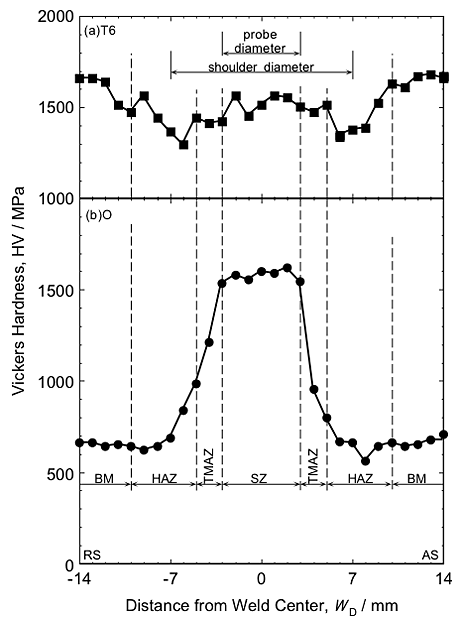
In this study, the tensile properties of friction stir welded 7075-T6 and 7075-O aluminum alloy joints at room temperature were investigated. After completion of the welding, the joints were subjected to a natural aging treatment and were then tested using a tensile machine. The strength of a T6 joint was less than that of the base material, as shown in Fig. 1 (a). This result is consistent with the finding that the Vickers hardness of the T6 joint was less than that of the base material, as shown in Fig. 2 (a). Fracture occurred in the stir zone of the T6 joint, and the fracture morphology of the joint revealed that it was a ductile fracture accompanied by fine dimples. Occasionally, the ductility of the T6 joint was more than that of the base metal; in these cases, intergranular fracture occurred. Intergranular fracture is reported to have been typically observed in precipitation-hardened aluminum alloys. Therefore, it is supposed that the difference in the fracture morphology of the T6 joint would be supposed the existing is the origin of the welding defects. On the other hand, the strength of an O joint was higher than that of the base metal, as shown in Fig. 1 (b). This result is in agreement with the finding that the Vickers hardness of the O joint was higher than that of the base metal, as shown in Fig. 2 (b). Fracture occurred in a thermo-mechanically affected zone of the O joint, and the fracture morphology of the joint was transgranular. The results on tensile elongation showed that the O joint had lower ductility than the base metal. The joint efficiency, which was calculated from the strength, was more than 80% for all joints. From the above-mentioned results, it could be concluded that these joints have good mechanical properties.
Tensile properties of friction stir welded 7075 aluminum alloy
at room temperature
Friction stir welding (FSW) is a relatively new solid-state bonding process. This process is energy efficient, environment friendly, and versatile. In particular, it can be used to join high-strength aluminum alloys and other metallic alloys that are hard to weld by conventional fusion welding. FSW is considered to be the most significant development in metal bonding in the last two decades.
[Published in Journal of Light Metal Welding, Vol.49, No.12 (2011), pp.467-473]
 |
|
Fig. 1 Nominal stress vs. nominal strain curves for friction stir welded joints and base metals: (a) 7075-T6 and (b) 7075-O. Specimens were naturally aged for 5 months after welding and were then tensile tested at room temperature at a strain rate of 1  10-3 s-1 . 10-3 s-1 . |
 |
|
| Fig. 2 Vickers hardness after natural aging as a function of the distance from the weld center for friction stir welded joints: (a) 7075-T6 and (b) 7075-O. |