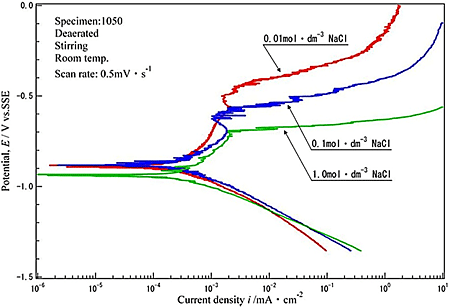
Attempts have been clarified anodic polarization behaviors between theoretical procedures which were divided from Nernst equation and experimental measurements of anodic curves of aluminum in solutions containing chloride ions of 0.01, 0.1, and 1.0 mol dm-3 by dynamic scanning method. The polarization curve of 1050 in 0.01 mol dm-3, 0.1 mol-dm-3, and 1.0 mol-dm-3 NaCl solution was measured. Typical curves are shown in Fig.1. All polarization curves have pitting potentials with vibrating. The pitting potentials of 1050 in NaCl solution were proportional to the logarithm of the chloride ion concentration in the solutions, and the relation of the following was obtained by 95% of the significance level.
Epit(NaCl) = = 0.710.21 log[Cl-] 0.710.21 log[Cl-] |
  (1) (1) |
where, [Cl-] is the concentration (mol dm-3) of the chloride ion in NaCl solution.
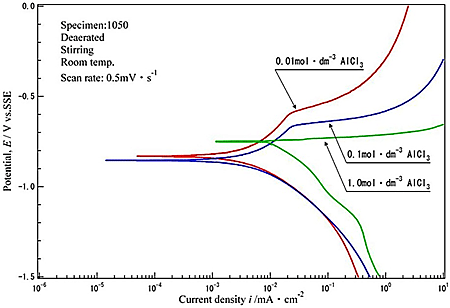
The polarization curves of 1050 in 0.01 mol dm-3, 0.1 mol dm-3, and 1.0 mol dm-3 AlCl3 solution were also measured. Typical curves are shown in Fig.2. All polarization curves do not have vibration phenomena compared with Fig.1 of NaCl solution and curves with being smooth . It is shown that pitting potentials appeared clearly. The pitting potentials in AlCl3 solutions were also proportional to the logarithm of the chloride ion concentration in the solutions, and the relation was obtained by 95% of the significance level.
| Epit(AlCl3)=0.700.08 log[Cl-] |
(2) |
where, [Cl-] is the concentration (mol dm-3) of the chloride ion in AlCl3 solution.
Stable chemical form of aluminm in neutral NaCl solution are Al(OH)3 from the potential-pH diagram. The corrosion reactions above are followings.
 |
Al + 3H2O  Al(OH)3 + 3H+ + 3e Al(OH)3 + 3H+ + 3e |
(3) |
|
| Al + 3Cl- AlCl3 + 3e |
(4) |
||
| AlCl3 Al3+ + 3Cl- |
(5) |
||
| Al3+ + 3H2O Al(OH)3 + 3H+ |
(6) |
||
| 6H2O + 6e 3H2 + 6OH- |
(7) |
Similarly, The corrosion reactions in AlCl3 solutions are followings.
 |
Al Al3+ + 3e |
(8) |
|
| Al + 3Cl- AlCl3 + 3e |
(4) |
||
| AlCl3 Al3+ + 3Cl- |
(5) |
||
| 6H+ + 6e 3H2 |
(9) |
The corrosion reactions aboves have no Cl- ion in conspicuous manner, but it is important to notice that Cl- ion has played significant role as promoting catalyst on the way of pitting corrosion process of aluminum. When it is supposed that the half-wave potential of the pitting reaction of aluminum may be equal to the pitting potential following relation will be obtained.
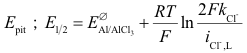 |
(10) |
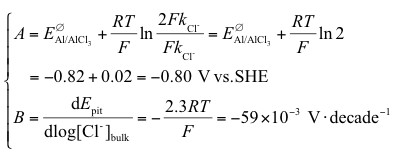
In this case, the relation with the experimental curve must be as follows.
 |
|
It is concluded that pitting potential observed on anodic polarization curves containing chloride ions were interpreted by cross point of superimposition of anodic reactions of Al/Al(OH)3 and Al/AlCl3, and was be estimated as half potential of anodic half reaction curve of Al/AlCl3.