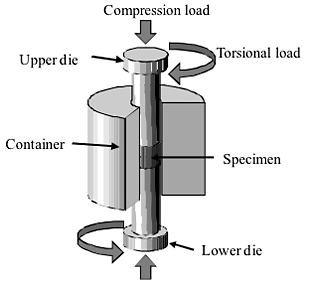
The compressive torsion process (CTP, Fig.1) was applied to the Al-4wt%Fe casting alloy ingot in order to refining large precipitates of Al-Fe intermetallic compounds and improving their mechanical properties. To examine the effects of CTP conditions on precipitate refinement and tensile property, the CTP was carried out under different processing temperatures (373-573K) and different numbers of torsional revolutions (1-30 times).
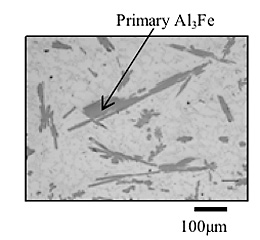
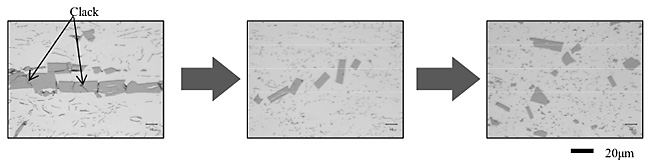
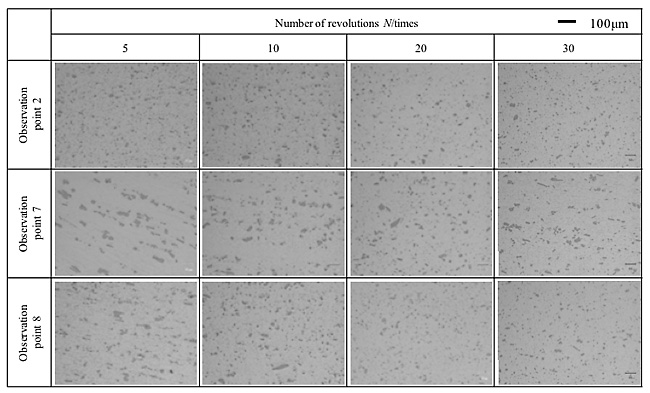
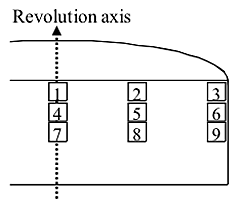
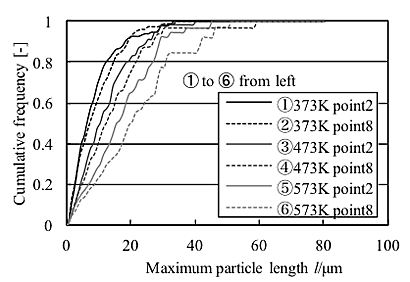
The casting ingot of the Al-4wt%Fe alloy has many large primary Al3Fe precipitates hundreds of micrometers in length as shown in Fig.2. Those large and brittle precipitates are broken by the severe plastic flow in CTP. And the broken precipitates are dispersed in the matrix alloy. Such breaking and dispersing are repeated during CTP and resulted in refinement of the precipitates. The change in the precipitates during CTP is shown in Fig.3. Fig.4 shows microstructure at different points in specimen shown in Fig.5 after CTP at 373K with different revolutions. The precipitate refinement and uniform dispersion were promoted with increasing number of torsional revolutions even at center of a cylindrical specimen. Fig.6 shows cumulative frequency of maximum particle length of precipitates after CTP at different temperature with 30 revolutions. The precipitate refinement was promoted with decreasing process temperature. As a result, the precipitates hundreds of micrometers are refined to 20  m or below under the optimum conditions of number of torsional revolutions and process temperature.
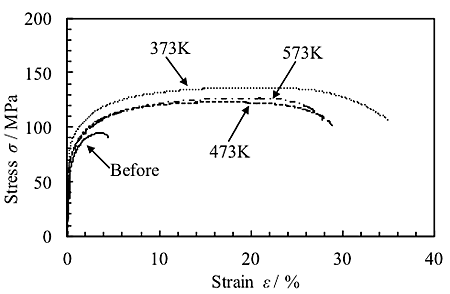
Fig.7 shows tensile stress-strain curves of Al-4%Fe alloy before and after CTP at different temperatures with 30 revolutions. The tensile property of the alloy processed by CTP was remarkably improved in both strength and ductility compared with that of the cast alloy before CTP. It was 1.7 times in tensile strength and about 8 times in total elongation. Thus, it was concluded that CTP is very effective in refining large precipitates and improving the ductility of Al-Fe alloy.